
Look around your home or store. Many items with the “Made in China” label likely passed through massive trading hubs. I’ve spent years navigating these centers as a sourcing professional.
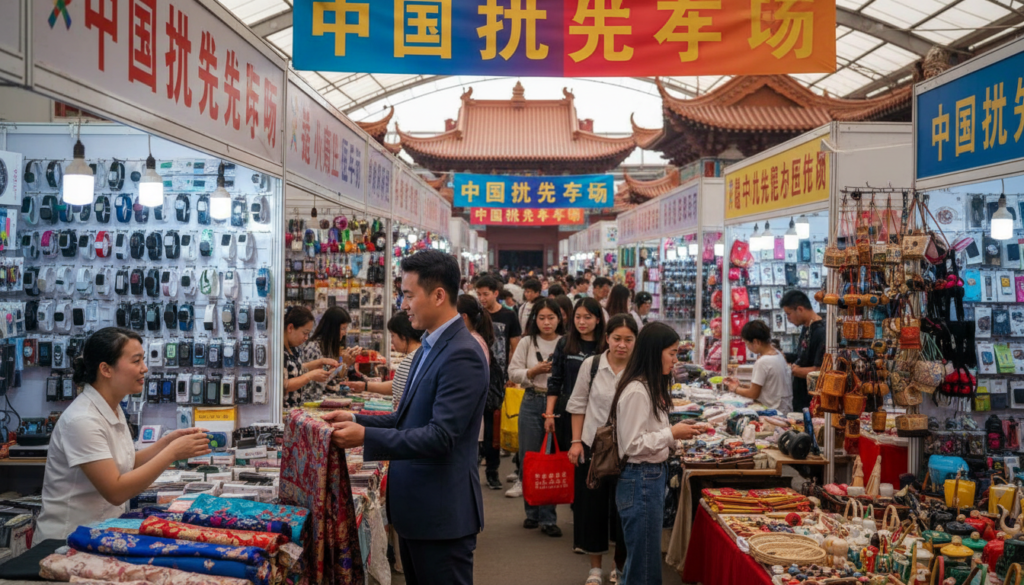
These physical locations are essential for importing toys, jewelry, or home goods. They offer a platform for face-to-face communication. You can see items with your own eyes and inspect materials up close.
You can also request price comparisons on the spot. Some goods in these bazaars can’t be found online. Many suppliers simply don’t conduct business on digital platforms.
I’m excited to share my comprehensive guide. It’s based on my direct experience visiting dozens of these hubs. I’ll help you tap into the world’s most extensive supply chain.
Key Takeaways
- Physical trading hubs allow for direct inspection and price negotiation.
- Many unique products are only available in person, not online.
- My guide is built on years of firsthand sourcing experience.
- These centers are organized by product specialty for efficient trips.
- Face-to-face interaction often yields better deals and product access.
- The ecosystem connects you directly to manufacturers and distributors.
- This knowledge saves significant time and money for your business.
Introduction to China Wholesale Markets
Stepping into my first wholesale market over twenty years ago felt like entering a bustling city dedicated entirely to commerce. The sheer scale and energy completely transformed how I saw global trade. These are physical places where thousands of vendors gather.
You find multi-story buildings with each floor focused on a specific product type. This organization makes sourcing incredibly efficient. You can walk from stall to stall, inspecting goods and talking directly with sellers.
This face-to-face interaction builds trust you can’t get online. You see materials up close and compare prices instantly. It feels much safer than just viewing pictures on a website.
My Sourcing Journey and First Impressions
I quickly learned many of the best suppliers operate only in these centers. They don’t have websites or online stores. This gives in-person buyers access to unique items not found elsewhere.
The system is built on product specialization. Entire districts focus on one industry, like electronics or textiles. My first impression was overwhelming noise and crowds.
I soon realized this organized chaos is a highly efficient business ecosystem. Understanding how these markets work is essential for serious sourcing. My personal experiences will help you navigate them successfully and find great deals.
The Importance of Wholesale Markets in Global Trade
While digital platforms grow, a foundational pillar of international trade remains firmly rooted in the real world. These massive physical centers are the engines of global commerce.
Connecting Buyers with Trusted Suppliers
I’ve seen these hubs facilitate billions in transactions yearly. They are critical infrastructure, linking global buyers directly with manufacturers.
The face-to-face nature builds trust that websites cannot match. My longest, most reliable partnerships started with a handshake in a busy aisle.
For suppliers, it means concentrated access to thousands of potential clients from around the world. For purchasers, it cuts through uncertainty. You inspect goods and talk to decision-makers on the spot.
| Feature | Physical Trade Hub | Online Platform |
|---|---|---|
| Product Inspection | Hands-on, immediate quality verification | Relies on photos and descriptions |
| Relationship Building | Direct, personal trust established | Often impersonal and transactional |
| Negotiation Power | Real-time discussion with key people | Slower, often through intermediaries |
| Access for Small Buyers | Access via wholesalers below factory MOQs | May have high minimum order requirements |
This system is a great equalizer. It lets smaller businesses source products effectively. That’s why this model continues to thrive, powering trade across the globe.
Uncovering China Wholesale Markets: Opportunities and Trends
One of the most powerful advantages I’ve discovered is the sheer concentration of production power in one location. This creates a unique environment where both opportunities and current trends are visibly at play.
Understanding Market Dynamics
The dynamics here are constantly evolving. Digital tools are now integrated into traditional trading practices.
Modernization has transformed how these centers operate. I’ve seen a clear shift towards showroom-style displays and better organization.
Integrated logistics services also simplify the entire buying process. This evolution is captured in the table below.
| Aspect | Traditional Model | Modern Approach |
|---|---|---|
| Product Display | Crowded stalls with samples | Curated showrooms |
| Buyer Support | Basic translation | Digital catalogs & payment systems |
| Logistics | Buyer arranges shipping | Integrated freight services |
| Information Access | Paper catalogs | Real-time inventory via apps |

Access to Thousands of Manufacturers
This concentration gives you direct access to thousands of manufacturers. You can compare dozens of suppliers offering similar items in one day.
That volume creates incredible negotiating power and product selection. The distribution networks linked to these hubs are highly sophisticated.
Products move from manufacturer floors to global store shelves with remarkable efficiency. For any buyer, this access to thousands of producers is a game-changer.
Yiwu: The Epicenter of International Trade
My first visit to Yiwu’s massive trade complex left me in awe of its sheer scale and organization. This city in Zhejiang Province is the undisputed hub for global small commodity sourcing.
It connects buyers with an unimaginable variety of goods. The entire economy here revolves around international trade.
Yiwu International Trade City Highlights
Known locally as Futian Market, the Yiwu International Trade City is the largest wholesale market on the planet. It’s a universe of products spread across five distinct districts.
You’ll find over 75,000 booths here. They specialize in toys, home decor, jewelry, and stationery.
The address is near Chouzhou North Road and Chengxin Avenue. I always tell people, “You haven’t seen sourcing until you’ve walked its endless aisles.”
Other Notable Yiwu Wholesale Destinations
Beyond the main complex, Yiwu hosts other specialized hubs. The International Production Materials Market at 1566 Xuefeng Xi Lu focuses on machinery and hardware.
For furniture, head to 1779 Xicheng Road. The Yiwu Furniture Market is the top-grade sourcing spot in the region.
Don’t miss the Huangyuan Clothing Market on Chouzhou Middle Road. It’s central Zhejiang’s largest garment bazaar.
My advice? Plan for 3-4 days minimum to explore properly. The depth of options across these yiwu market locations is truly transformative for any business.
Clothing, Accessories, and Fashion Markets in China
When I think of sourcing apparel, my mind immediately goes to the vibrant, sprawling garment districts of Guangdong Province. Guangzhou is the nation’s undisputed fashion capital. Its numerous hubs serve global buyers with an incredible range of products.
Key Guangzhou Garment Hubs
The Baima Clothing Wholesale Market, established in 1993 at No. 16 Zhannan Road, is an eight-floor fashion empire. I’ve sourced high-end boutique women’s wear on the first floor. The upper levels cater to mid-range and men’s fashion.
For a Korean aesthetic, Cotton Tree International Fashion City at 184 Huanshi West Road is essential. It spans 60,000 square meters with over 1,800 suppliers. This center specializes in middle and high-grade fashion clothing.
Budget buyers should target The Thirteen-hong market on Thirteen Road. It’s a leader in fast fashion with very competitive prices. The Guangzhou Shahe Garment Market opens at 3-4 AM for the earliest product access.
Zhanxi Garment Wholesale City focuses on medium and low-grade export-quality pieces. Huimei International showcases all the hot-style clothing trending online. For unique designs, Guangzhou U:US features nearly 500 original brands from China and South Korea.
These centers also have extensive sections for bags, jewelry, and other accessories. You can find excellent children clothing and a full spectrum of fabrics, from budget to premium.
Diverse Sourcing: Electronics, Furniture, and More
The true power of sourcing lies in the incredible diversity of specialized product hubs beyond just apparel. I’ve found that expanding into new categories like electronics and home goods can dramatically boost your business.
These focused centers offer expert vendors and deep product selections.
Electronics and Gadget Centers
For electronics, my go-to destination is Huaqiang Electronic World in Shenzhen. Established in 1998, it’s the largest and most complete professional wholesale market for gadgets and components in the country.
The entire Huaqiang North Business Zone contains 11 large markets, including Seg Electronics and Cyber. This creates an entire ecosystem where you can find any product, from smartphones to obscure circuit boards.
Furniture, Home, and Accessories Markets
When sourcing furniture, I head to the Yiwu Furniture Market at 1779 Xicheng Road. It’s the modern furniture center with the largest scale and highest grade in Zhejiang Province.
Its five floors are meticulously organized. You’ll find common home and office pieces on B1, sofas and hardware on F1, and premium solid wood designs on F4.
For toys and boutique home accessories, Wanling Square in Guangzhou is a 41-floor landmark. Floors B1 through F6 specialize in decorative goods and playthings.
Major toys production hubs like Chenghai and Shandong Linyi also offer self-produced items at attractive prices. Visiting these places lets you inspect materials like wood, metal, and glass up close. You can compare products from dozens of suppliers in one efficient trip.
Evaluating Supplier Quality and Reliability
Nothing beats the confidence that comes from shaking a supplier’s hand and inspecting their goods in person. This direct interaction is the cornerstone of building a secure supply chain.
You can see the product with your own eyes and feel the materials. This hands-on check is impossible through a screen.
Advantages of Face-to-Face Communication
I physically examine quality by checking stitching, finishes, and weight. Photos often hide flaws that are obvious up close.
I always collect samples of the same item from multiple suppliers. Side-by-side comparison reveals who meets my standards.
Face-to-face meetings let buyers ask detailed questions. You can read body language and gauge honesty about manufacturing processes.
Observing how a vendor maintains their booth tells me about their professionalism. Those with permanent stalls invest in their reputation.
This environment makes price negotiation immediate and transparent. You feel safer than buying unseen items online.
| Assessment Factor | In-Person Evaluation | Online Evaluation |
|---|---|---|
| Material & Construction | Hands-on inspection for flaws and feel | Relies on provided photos and descriptions |
| Supplier Professionalism | Observe booth upkeep and client interactions | Limited to response speed and website design |
| Sample Comparison | Physical side-by-side analysis of multiple items | Difficult to coordinate and compare accurately |
| Relationship Building | Direct trust established through personal contact | Often remains impersonal and transactional |
Repeated visits build strong relationships with reliable suppliers. This trust leads to better pricing and priority service for loyal buyers.
Navigating Logistics and Order Management
I’ve seen countless deals fall apart not because of product quality, but due to poor planning in the shipping and distribution phase. Getting your purchases from the trading floor to your door is a critical skill.
Most major hubs have dedicated logistics centers right on-site. This makes consolidating and exporting your goods much simpler. I always partner with experienced freight forwarders who know the local procedures.
These specialists negotiate better shipping rates and handle complex paperwork. The distribution networks here are highly developed. They offer everything from domestic trucking to international air and ocean freight.
When I buy from multiple vendors, I coordinate delivery to a single consolidation point. There, items can be inspected and repacked for safe export. Understanding timelines is crucial.
You must factor in production, domestic transport, customs, and international shipping. Many centers now provide integrated logistics services. They offer warehousing, quality checks, and shipping coordination.
Building relationships with reliable providers is as vital as finding good suppliers. Your products must arrive on time and in perfect condition.
Leveraging Digital Platforms for Wholesale Sourcing
While nothing replaces walking the aisles, I’ve learned that smart sourcing now requires a strong online component. Digital tools have become essential partners in my strategy.
They let me research and connect with vendors before I ever book a flight. This preparation makes my physical trips far more productive.
Insights from Made-in-China.com and Other Sites
Platforms like Made-in-China.com are invaluable for preliminary research. I can identify potential partners and compare their products from my desk.
One Amazon seller told me how the site helped negotiate lower minimum order quantities. The platform facilitated direct talks with the suppliers.

An eBay seller built a profitable drop-shipping business using their catalog. She now manages it as a part-time job from anywhere.
For first-time buyers, these sites offer clear communication and reduce intimidation. Quick answers to product questions build confidence.
| Feature | Digital Platform Sourcing | Physical Market Sourcing |
|---|---|---|
| Initial Contact | Fast, from anywhere with internet | Requires travel, but builds immediate trust |
| Product Research | Easy to compare vast catalogs online | Hands-on inspection of materials and quality |
| MOQ Negotiation | Often facilitated by platform mediators | Direct, face-to-face haggling on the spot |
| Ongoing Management | Streamlined reorders and shipment tracking | Relies on personal relationships and calls |
I use digital tools to maintain relationships after meeting suppliers in person. This hybrid approach is the most effective sourcing method I know.
Industry Insights: Voices from Buyers and Sellers
Let’s shift perspective for a moment and hear directly from the people who are making it work in the real world. Learning from other successful buyers provides invaluable shortcuts in global sourcing.
Amazon and eBay Seller Experiences
One Amazon seller faced high minimum order quantities. They didn’t just accept the terms.
“The MOQs of a supplier are too high… Made-in-China.com told me how to contact the supplier and confirm the details. I will try.”
This shows the power of communication. An eBay seller built a profitable part-time business.
“I currently have a 15 percent profit margin. Last month I made $3,100. Not bad for a part-time job that I can manage anywhere.”
Their success came from drop-shipping arrangements. This model lets suppliers ship products directly to customers.
Real Testimonials and Trade Success Stories
A B2C platform CEO saw dramatic growth by optimizing their strategy.
“My sales increased 100% in my bedding niche after working with Made-in-China.com!… Made-in-China.com makes eCommerce easier when you find this all under one platform.”
These stories highlight common success factors. The table below breaks down the key lessons.
| Seller Type | Key Challenge | Solution | Outcome |
|---|---|---|---|
| Amazon Seller | High Minimum Order Quantity | Direct negotiation facilitated by platform | Access to better terms for smaller buyers |
| eBay Seller | Inventory risk & capital | Adopting a drop-shipping model | Healthy profit margin with low overhead |
| B2C CEO | Scaling a niche product line | Using integrated platform for ordering & tracking | Doubled sales through reliable quality and logistics |
The pattern is clear. Successful buyers prioritize quality and relationships over just price.
They use tools to streamline operations. This mindset opens up tremendous wholesale trade opportunities for any business.
Regional Highlights: Guangdong, Zhejiang, and Other Key Areas
My travels have taught me that the most efficient sourcing trips are planned around regional specializations. Entire cities become hubs for single industries.
Guangdong Province and Zhejiang Province are two epicenters. The first is a powerhouse for apparel and electronics. The second dominates in small commodities and textiles.
Distinct Characteristics of Regional Markets
Other regions boast incredible concentration. Jinjiang City is a world-renowned shoe industry center. It’s the largest sports shoe production and trading base globally.
In Zhejiang Province, find the Shaoxing Keqiao China Textile City. It’s the largest textile distribution center with the most varieties. Hangzhou Silk City is the premier silk textile city.
For specialized goods, look to specific bases. The Gaoyou zone is the world’s largest down clothing production base. Danyang Glasses City produces a huge share of the world’s lenses.
Understanding these regional specializations lets you target the right area. You tap into complete ecosystems, from raw materials to finished goods.
Expert Tips to Maximize Your Buying Experience
I’ve learned that the early bird doesn’t just get the worm; in sourcing, they get the best prices and first pick of inventory. My expert tips will help you secure great deals without sacrificing quality.
Timing matters enormously. The Guangzhou Shahe Garment Market opens at 3-4 AM. Arriving early gives you first access to suppliers before crowds arrive.

Negotiation Strategies and Best Practices
My strategy always involves visiting multiple suppliers. I take notes on prices and quality for similar products. Then, I return to my preferred vendor with competitive information.
Never accept the first quoted price. Suppliers expect negotiation. I typically achieve 10-30% reductions through respectful but firm bargaining.
Building relationships over multiple visits creates trust. This often results in better pricing and priority treatment. Position yourself as a repeat buyer to improve leverage.
For clothing and fashion products, I recommend markets like the thirteen-hong of Canton. It offers some of the cheapest and most current styles. Always compare quality-to-price ratios.
| Strategy | Effective Approach | Ineffective Approach |
|---|---|---|
| Timing | Shop at opening for best selection and prices | Arriving late when crowds are high |
| Price Negotiation | Use quotes from competitors as leverage | Accepting the first price offered |
| Relationship Building | Focus on long-term partnership potential | Treating each transaction as one-time |
Always verify what quoted prices include. Clarify if costs cover local delivery to prevent surprises. Sample orders before committing to large purchases.
Dress professionally and conduct yourself seriously. Suppliers offer better prices to those they perceive as genuine business buyers.
My Personal Success Stories in Wholesale Trade
Reflecting on my career, the most rewarding moments weren’t the biggest deals, but the transformations I witnessed in small businesses. One client started with a single store. We sourced home décor together.
That partnership grew into a regional chain. It was built on reliable sourcing and consistent quality. This story shows how global trade can create real opportunity.
Lessons Learned from Years of Sourcing
I learned that success isn’t about the lowest price. It’s about building sustainable relationships. Personal connections in business culture are everything.
Patience and clear communication prevent costly misunderstandings. I’ve seen the entire ecosystem evolve. It moved from simple transactions to sophisticated operations.
| Core Lesson | Traditional Impact | Future Application |
|---|---|---|
| Relationship Focus | Built trust for better pricing & priority | Foundation for direct-to-consumer & sustainable manufacturing partnerships |
| Quality Over Price | Ensured customer satisfaction & repeat business | Key for brands in a transparent, review-driven world |
| Adaptive Communication | Navigated cultural gaps in export deals | Essential for leveraging digital tools & remote sourcing |
Future Opportunities in Global Trade
The world of international trade is more accessible than ever. Innovation in manufacturing creates new product categories every day.
Small and medium businesses can now enter this space. Sustainable practices and direct models are the next frontier. My experience proves that ethical, informed sourcing consistently outperforms chasing the lowest cost.
The future is bright for those who learn the systems. China wholesale channels remain a powerful launchpad for global ambition.
Conclusion
Navigating these vast commercial ecosystems has taught me that success hinges on more than just a good price—it’s about trust built face-to-face. My guide, drawn from years of experience, shows you the immense variety available. From massive trade cities to specialized hubs for clothing, electronics, and home goods, the options are staggering.
The real power lies in personal inspection and direct negotiation. You can feel materials, compare quality instantly, and build relationships that last. This creates long-term value no website can match.
Successful sourcing demands attention to detail, logistics knowledge, and understanding regional strengths. These centers support everyone, from Amazon sellers to boutique owners. They evolve with digital tools but keep their human core.
Start your journey by identifying the right market for your product needs. Plan a visit to experience this dynamic world of trade firsthand. It remains a central pillar of global commerce for a very good reason.